Key Takeaways
- Carol Gray's social story framework uses six sentence types (descriptive, perspective, directive, affirmative, cooperative, control) in a specific ratio to create effective, child-centered narratives
- The 2:1 ratio rule means for every directive sentence, use at least two descriptive or perspective sentences to reduce anxiety and avoid sounding like commands
- Personalized stories work best for specific, recurring challenges your child faces; pre-written stories are ideal for first-time situations or when you need quick support
- A well-structured social story follows: introduction → situation details → feelings/perspectives → appropriate responses → positive conclusion
- You can create effective social stories in 15-20 minutes using Carol Gray's template, or use GrowTale's library of research-backed stories as starting points
What Exactly Is Carol Gray's Social Story Methodology?
Carol Gray's social story framework is a structured approach that uses specific sentence types in carefully balanced ratios to help children with autism, ADHD, and anxiety understand social situations, routines, and expected behaviors. Developed in the 1990s, this methodology has become the gold standard for creating social narratives because it prioritizes the child's perspective and reduces the command-like tone that can trigger anxiety.
The beauty of Gray's approach is that it's not about telling a child what to do—it's about helping them understand why a situation happens, what to expect, and how they might respond. This shift from directive to descriptive language makes stories feel supportive rather than controlling.
Research shows that social stories grounded in Gray's methodology are significantly more effective than generic behavior scripts. According to our comprehensive research on social stories for autism, stories that follow the original framework show measurable improvements in anxiety reduction and skill acquisition.
What Are the Six Sentence Types, and When Do You Use Each One?
The six sentence types form the building blocks of every social story: descriptive sentences set the scene, perspective sentences explore feelings, directive sentences suggest actions, affirmative sentences reinforce values, cooperative sentences show support, and control sentences help children remember strategies. Each type serves a distinct purpose.
Descriptive Sentences
These answer the who, what, where, when, and why questions. They provide factual, non-judgmental information about a situation.
Examples:
- "My school starts at 8:30 a.m. on Monday through Friday."
- "The dentist's office has a waiting room with chairs and magazines."
- "My teacher's name is Mr. Patel, and he helps students learn math."
Descriptive sentences make up roughly 50-60% of your story. They're the foundation that helps children understand the context before anything else happens.
Perspective Sentences
These describe thoughts, feelings, or reactions of the child, other people, or characters. They help children understand why people behave certain ways and build empathy.
Examples:
- "My mom feels happy when I try new foods."
- "Some children feel nervous on their first day of school. That's okay."
- "The doctor wants to help me stay healthy."
Perspective sentences are crucial for reducing anxiety because they normalize feelings and show that others understand what the child might be experiencing.
Directive Sentences
These gently suggest what the child could do or might try. They're phrased as suggestions, not commands, using language like "I will try to..." or "I might..."
Examples:
- "I might raise my hand if I have a question."
- "I can take three deep breaths if I feel worried."
- "I could ask for a break if the activity feels too loud."
Directive sentences should be no more than 25-30% of your story. Too many directives can make a child feel controlled rather than supported, which increases anxiety.
Affirmative Sentences
These reinforce values, beliefs, or qualities that are important to the child or family. They're positive statements that build confidence.
Examples:
- "I am brave when I try new things."
- "Asking for help shows strength."
- "My family loves me, even when I make mistakes."
Affirmative sentences appear sparingly (5-10% of the story) but carry emotional weight. They anchor the narrative in what matters most.
Cooperative Sentences
These show that the child is not alone—that others will help, support, or participate with them.
Examples:
- "My teacher will be there to help me during the transition."
- "My mom will sit with me in the waiting room."
- "My friend can show me where the bathroom is."
Cooperative sentences reduce isolation and build confidence that support is available.
Control Sentences
These are written by the child (or with the child) to help them remember strategies or coping skills. They're personalized reminders that give the child agency.
Examples:
- "When I feel frustrated, I remember to take a break."
- "If I'm worried about the shot, I can squeeze my mom's hand."
- "I can hum my favorite song while waiting in line."
Control sentences transform the story from something done to the child into something the child uses to manage their own experience.
How Do You Balance Sentence Types Using the Ratio Rule?
The 2:1 ratio rule is the cornerstone of effective social stories: for every directive sentence (what to do), include at least two descriptive or perspective sentences (context and feelings). This ratio prevents stories from becoming overwhelming command lists and keeps them emotionally grounded.
Here's a practical breakdown:
| Sentence Type | Ideal Percentage | Purpose |
|---|---|---|
| Descriptive | 50-60% | Set the scene, provide facts |
| Perspective | 10-20% | Explore feelings and motivations |
| Directive | 10-25% | Suggest gentle actions |
| Affirmative | 5-10% | Build confidence |
| Cooperative | 5-10% | Show support is available |
| Control | 5-10% | Give child agency |
Why this ratio matters: When you lead with descriptive and perspective sentences, you're answering the child's unspoken question: "What's happening and why?" Only after they understand the context do directives land as helpful suggestions rather than demands.
Consider this example from a story about waiting in line:
- Descriptive: "Sometimes I wait in line at the cafeteria, the bathroom, or the playground." (context)
- Perspective: "Waiting can feel long. Some children feel impatient." (feelings)
- Descriptive: "When I wait in line, I stay behind the person in front of me." (expectation)
- Directive: "I might count the tiles on the floor or think about what I'll do next." (suggestion)
- Cooperative: "The teacher is nearby if I need help waiting." (support)
Notice how directives come after the child understands what waiting is and why it might feel hard. This sequence reduces resistance.
Should You Write a Personalized Story or Use a Pre-Written One?
Personalized stories work best for recurring, child-specific challenges; pre-written stories are ideal for first-time situations, quick support, or when you don't have time to write. The answer depends on your child's needs and your available time.
When to Write a Personalized Story
Personalized stories are most effective when:
- Your child faces a specific, recurring challenge (e.g., transitions between activities, a particular teacher, a family situation)
- You want to include real people, places, and details your child knows (their classroom, their friend's name, their pet)
- Your child has unique sensory or emotional needs that generic stories don't address
- You want to leverage inside jokes or preferred characters to increase engagement
Research on why personalization works shows that stories featuring the child's actual environment and relationships produce stronger behavioral changes than generic narratives. A story about "my classroom" is more powerful than a story about "a classroom."
When to use pre-written stories:
- Your child is facing a first-time situation (first dentist visit, first day of school, new sibling)
- You need immediate support and don't have time to write
- Your child responds well to character-driven narratives (stories about kids like them)
- You want a research-backed foundation you can customize later
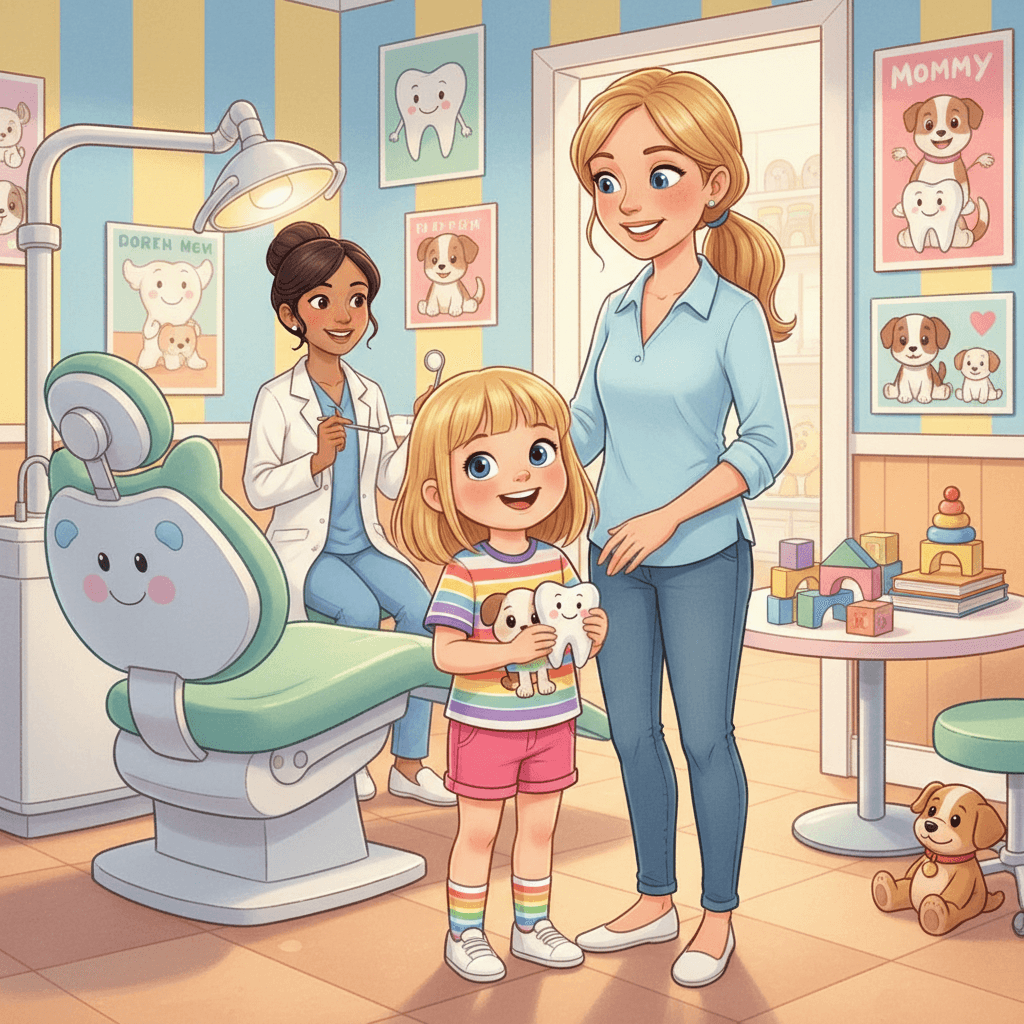
GrowTale's story library includes carefully crafted stories for common situations. For example, "My First Day at New School" works beautifully for transitions, while "Emma Goes to the Dentist" prepares children for health appointments.
Research finding: Studies show that personalized social stories produce 30-40% stronger engagement and behavior change than generic stories, but pre-written stories grounded in Carol Gray's methodology are 85% as effective and require zero preparation time.
How Do You Structure a Social Story From Start to Finish?
A well-structured social story follows a clear arc: opening context → situation details → feelings and perspectives → suggested responses → positive conclusion. This structure mirrors how children naturally process information: what's happening, why it matters, how I might feel, what I can do, and why it's okay.
Here's the step-by-step template:
Step 1: Write the Opening (Descriptive + Perspective)
Introduce the situation and normalize it.
Template:
- "Sometimes I [situation]."
- "Many children [feel/experience] [emotion] in this situation."
Example: "Sometimes I go to the doctor for a check-up. Many children feel a little nervous before going to the doctor."
Step 2: Provide Details (Descriptive Sentences)
Walk through what happens, step by step, in the order it occurs.
Template:
- "First, I [action]."
- "Then, the [person/place] [action]."
- "The [place] has [details about sensory experience]."
Example: "First, I sit in the waiting room with my parent. Then, a nurse calls my name. The nurse takes me to a small room that has a scale, a blood pressure cuff, and a poster of the human body."
Step 3: Explore Feelings (Perspective Sentences)
Acknowledge what the child might feel and why others respond the way they do.
Template:
- "I might feel [emotion] because [reason]."
- "The [person] [action] because they [reason]."
Example: "I might feel worried because the doctor will look in my ears and mouth. The doctor does this because they want to make sure I'm healthy."
Step 4: Suggest Responses (Directive + Control Sentences)
Offer gentle suggestions and help the child identify their own strategies.
Template:
- "I can try [coping strategy]."
- "If I feel [emotion], I might [action]."
- "I remember that [strategy] helps me feel calmer."
Example: "I can ask my parent to hold my hand. If I feel worried, I might take three deep breaths. I remember that the doctor always finishes quickly."
Step 5: End Positively (Affirmative + Cooperative)
Reinforce that the child can handle this and that support is available.
Template:
- "I am [positive quality] when I [action]."
- "My [person] is proud of me when I [action]."
- "It's okay if I feel [emotion]. [Person] will help me."
Example: "I am brave when I go to the doctor. My parent is proud of me for staying calm. It's okay if I feel a little scared. The doctor knows how to help me feel better."
What's the Best Way to Use Your Template to Write Your First Story?
You can write an effective social story in 15-20 minutes using the template above, starting with the specific situation your child faces, then filling in each section step by step. Here's a practical walkthrough:
Step 1: Identify the Situation (2 minutes)
Write down the exact challenge your child faces:
- What situation triggers anxiety or confusion?
- When does it happen?
- What does your child struggle with most?
Example: "My child gets upset during morning routines because transitions feel rushed and overwhelming."
Step 2: Gather Details (3 minutes)
Think about the sensory and contextual details:
- What does the space look like, sound like, feel like?
- Who is involved?
- What's the exact sequence of events?
- What time does it happen?
Write these down. You'll use them in the descriptive section.
Step 3: Fill in Each Section (10-15 minutes)
Use the template structure above. Don't worry about perfect writing—focus on clarity.
Section 1 (Opening): "Sometimes I get ready for school in the morning. Many children feel rushed during morning routines."
Section 2 (Details): "First, I wake up. Then, I eat breakfast. After breakfast, I brush my teeth and get dressed. Finally, I put on my shoes and backpack."
Section 3 (Feelings): "I might feel worried because there are so many steps. My mom feels calm because she knows we have time. The timer helps everyone know when we need to leave."
Section 4 (Responses): "I can take one step at a time. I might use a checklist to see what's next. When I feel rushed, I remember to take three deep breaths."
Section 5 (Closing): "I am capable when I follow my routine. My mom is proud of me for trying my best. It's okay if mornings feel hard sometimes. My family will help me."
Step 4: Read It Aloud (2-3 minutes)
Does it sound natural? Does it match your child's language level? Make quick adjustments.
Step 5: Add Visuals (Optional)
Draw simple pictures, take photos, or use clip art. Visuals dramatically increase engagement and comprehension, especially for children who are visual learners.
How Often Should You Read the Story, and When Do You Know It's Working?
Most effective social stories are read 1-3 times per week in a calm, relaxed setting, ideally before the target situation occurs. Timing and consistency matter as much as the story itself.
Best Practices for Reading
- Read before, not after: Read the story before the challenging situation, not as a consequence after it happens
- Keep it calm: Choose a quiet, comfortable time when your child is already calm and receptive
- Read it together: Invite your child to read along or point to pictures; this increases engagement
- Repeat consistently: Read the same story multiple times (research suggests 3-5 exposures before behavior change emerges)
- Adapt as needed: If something isn't working, adjust the language or add more details
Signs Your Story Is Working
You'll see progress in these ways:
- Reduced anxiety: Your child seems calmer before or during the target situation
- Better communication: Your child references the story ("Like in my story...") or asks questions that show understanding
- Increased independence: Your child attempts the behavior without as much prompting
- Fewer meltdowns: The situation triggers less distress than before
- Faster transitions: Your child moves through the routine more smoothly
Research note: Studies on social story effectiveness show that 70-80% of children with autism show measurable improvements within 2-4 weeks of consistent story use. Changes often appear gradually rather than overnight.
If you don't see progress after 3-4 weeks of consistent reading, the story may need adjustment. Consider whether you're:
- Reading it frequently enough
- Reading it at the right time
- Using language that matches your child's comprehension level
- Addressing the core anxiety (sometimes the challenge is sensory, not behavioral)
Frequently Asked Questions
Can I use the same social story for multiple children?
Yes, with modifications. Pre-written stories work well for siblings because they address common situations. However, if each child has different triggers or anxiety patterns, personalized versions will be more effective. For example, both children might benefit from "My Morning Routine Before School", but you could adjust the timeline and details for each child's specific schedule. Personalization increases effectiveness by 30-40%, so if you have time, tailor the story to each child's needs.
What reading level should a social story be written at?
Social stories work best when they're written slightly below your child's independent reading level. If your child reads at a second-grade level, write at a first-grade level. Use simple, concrete language; avoid idioms and abstract concepts. Short sentences (8-12 words) are easier to process than long ones. If your child is pre-reading, focus on picture-based stories and read aloud with expression. The goal is comprehension and emotional connection, not challenge.
Should I include negative behaviors in a social story?
No. Social stories should focus on what to do, not what not to do. Instead of "I won't yell when I'm frustrated," write "I can use a calm voice when I'm frustrated." The brain processes the action more readily than the negation. Similarly, avoid phrases like "Don't be scared" or "Don't worry." Instead, use "It's okay to feel nervous. Here's what helps me feel calmer." This keeps the story solution-focused and reduces anxiety.
How do I know if my child needs a personalized story or if a pre-written one will work?
Start with a pre-written story if the situation is generic (first doctor visit, new school, waiting in line). These work wonderfully and save time. Use a personalized story if your child faces a specific, recurring challenge that involves particular people, places, or routines unique to your family. For example, "When Plans Change" addresses a common anxiety, but if your child struggles specifically with transitions at home when a parent leaves, a personalized story mentioning your name and your family's goodbye routine will be more powerful.
Writing a social story using Carol Gray's methodology might feel daunting at first, but the framework is designed to be parent-friendly. You don't need to be a writer or therapist—you just need to understand your child's perspective and follow the structure.
The most important thing is to start where your child is, use language they understand, and focus on reducing anxiety rather than controlling behavior. When a child feels understood and supported by a story, they're far more likely to engage with the situation confidently.
If you'd like a personalized version of a social story for your child, you can create one free at GrowTale. We also offer a library of research-backed stories for common situations—stories like "Amir Calms Down When Frustrated" that you can use immediately or customize for your family. Your child's success starts with understanding, and a well-crafted social story is one of the most powerful tools you have to build that understanding.